


January 06 : 2026
Mark Fernley
Mark’s documentation of African wildlife reflects his deep patience and intimate knowledge of the landscapes he explores, paired with an uncanny ability to capture moments of rare beauty and quiet majesty.
by Lily Fierman


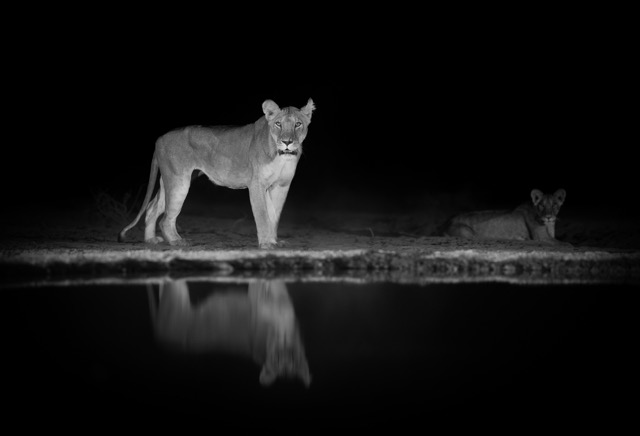
Image: Crowned in Dust and Shadow
Q:
Can you please tell us more about creating your winning image, “Crowned in Dust and Shadow”?
A:
This photograph was taken deep into the night at Shompole Conservancy while leading a wildlife photo trip with my company, Untamed Photo Safaris. The shot was taken around three in the morning, from a photographic safari hide known as Shompole Plains Hide that had become almost a second home to me. By this point, I had been photographing from the hide for nearly two months, learning the rhythms of the waterhole and the subtle signals that told me when something important was about to happen. On this particular night, the hide was alive with activity. Elephants arrived in slow, deliberate groups, their reflections trembling on the water’s surface. Giraffe stepped in cautiously, legs splayed, while impala and zebra came and went in nervous bursts. A serval ghosted through the edges of the light, and hyenas lingered just beyond it, ever patient.
Eventually, as it so often does, the waterhole fell quiet. The silence was not empty, but expectant. Then the baboons began calling from the darkness. That sound is never random. It is an alarm, and I knew immediately that predators were close. Not long after, the lions emerged, shapes forming out of shadow, their presence felt before it was fully seen. I photographed them as they drank, their faces lit low and clean, eyes reflecting a calm confidence that only lions carry at night.
While the lions were at the water, the hyenas lurked in the distance, testing boundaries. One young male lion, full of energy and bravado, began racing back and forth in front of the hide. Each charge sent dust billowing up from the dry ground, momentarily catching the light before dissolving back into the dark. In that instant, instinct took over. I turned up the backlight, knowing exactly what it would do. The dust ignited in the beam, wrapping the lion in a glowing haze that transformed the scene into something almost unreal.
The image captures the lion in profile, powerful and alert, standing in a cloud of illuminated dust that looks more like smoke than earth. The ground beneath him is dark and solid, while the air around him feels alive, swirling with motion and tension. His reflection lingers faintly in the water below, a soft echo of his presence, grounding the image back in reality. The contrast between the sharpness of the lion and the softness of the dust gives the photograph its drama, turning a fleeting moment into something sculptural and timeless.
Technically, the image was taken on a Canon R5 paired with an EF 70–200mm f/2.8. The camera was kept still due to the slow shutter speed of 1/160, Fstop at 2.8 and ISO at 5000. I used first curtain shutter to prevent any flicker from the backlight, which was critical in maintaining the clean, consistent illumination of the dust. The hide itself is open, placing you incredibly close to the animals and below their eye level. That proximity is exhilarating and unnerving in equal measure. Sitting there in the darkness, with lions just meters away, heart racing, you are reminded that this is their world. When everything aligns, preparation, patience, instinct, and respect for the moment, you do not just take a photograph. You witness something raw, fleeting, and unforgettable.



The strongest images come from understanding the environment and being ready when a moment finally unfolds.
Q:
All of your work holds a sense of drama, whether its the scale of the subject in the frame or the lighting. How did you come to find yourself working in this style?
A:
That sense of drama came naturally from time spent in the field rather than from any conscious decision to create a “style.” When you spend long periods with wildlife, especially at night and from hides, you start to see how light, space, and timing shape a moment far more than the subject alone. Predators emerging from darkness, dust hanging in the air, reflections on still water, or an animal stepping briefly into a pool of light all carry their own tension and scale.
Working from photographic hides has been a huge influence. Being below eye level and very close to animals changes everything. You are no longer photographing wildlife from a distance; you are immersed in their world. That proximity heightens the drama on its own, and my role becomes one of restraint, waiting for the scene to build rather than forcing it.
Lighting is used in the same way. I am not trying to overpower the scene, but to reveal what is already there, shape, texture, movement, and atmosphere. Often the most dramatic moments come after things go quiet, when the obvious action has passed and the environment starts to breathe again.
Over time, this way of working has become instinctive. I focus less on documenting what I see and more on translating how it feels to be there. If the image carries drama, it is because the moment itself was dramatic, and I was patient enough to let it unfold.

Q:
Since you spend so much time on safari guiding tours, we’d love to know one of the wildest moments of your time in the field.
A:
One of the most intense moments I have experienced in the field happened in Namibia, while photographing hippos from a tiny boat on a remote stretch of water. We were low to the surface, quietly drifting, when a massive bull hippo surfaced far closer than expected. In an instant, the mood shifted. His body language changed, and before we had time to react, he charged.
The boat surged forward as the hippo came straight at us, jaws open, water exploding around his head. From that low vantage point, the scale was overwhelming. Every second felt stretched, the engine struggling as we tried to put distance between ourselves and an animal that can move far faster than most people realise. At one point, he came so close that the wake from his charge rocked the boat violently, threatening to tip us.
It was a stark reminder that wildlife photography is not about control. It demands awareness, respect, and knowing when to put the camera down and focus on getting out safely.
Q:
What do you wish folks knew about wildlife photography on safari that they might not?
A:
Patience and strategy are essential on a photo safari. Wildlife cannot be rushed or directed. You learn to read behaviour, anticipate movement, and wait through long quiet periods. The strongest images come from understanding the environment and being ready when a moment finally unfolds.
Q:
What is your dream subject?
A:
The mandrill is my dream subject to photograph because it represents one of the most visually striking and least accessible primates in the wild. Its bold colouration, intense facial expression, and complex social behaviour offer endless photographic depth. Found deep within dense rainforest, mandrills demand patience, physical effort, and respect for their environment. Photographing one is not just about the image, but about immersion in a challenging ecosystem where light is limited and moments are fleeting. For me, the mandrill symbolises the next level of wildlife photography, where technical skill, fieldcraft, and storytelling come together in a single, powerful encounter. Soon my photo safari company Untamed Photo Safaris will be leading photo tours in Gabon to photograph these wonderful animals in the near future.


Q:
What are you working on now?
A:
I am currently working on a photographic book about the wildlife of Africa with my wife, who is also a wildlife photographer and photo host with Untamed Photo Safaris. Together, we continue to explore the continent, seeking out and documenting its wildest and most remote corners. Alongside this work, we remain deeply committed to education and host others in the field through our specialist photographic safaris with Untamed Photo Safaris. As owners of the company, our focus is on creating immersive, ethically driven photography experiences across Kenya, Tanzania, and Uganda.
Q:
Who are some photographers you admire?
A:
Jonathan and Angela Scott inspire me through their ability to combine powerful wildlife photography with genuine conservation impact. Their work goes beyond aesthetics, using patience, empathy, and long term commitment to tell meaningful stories that create emotional connections and encourage protection of the natural world.
ARTIST

